
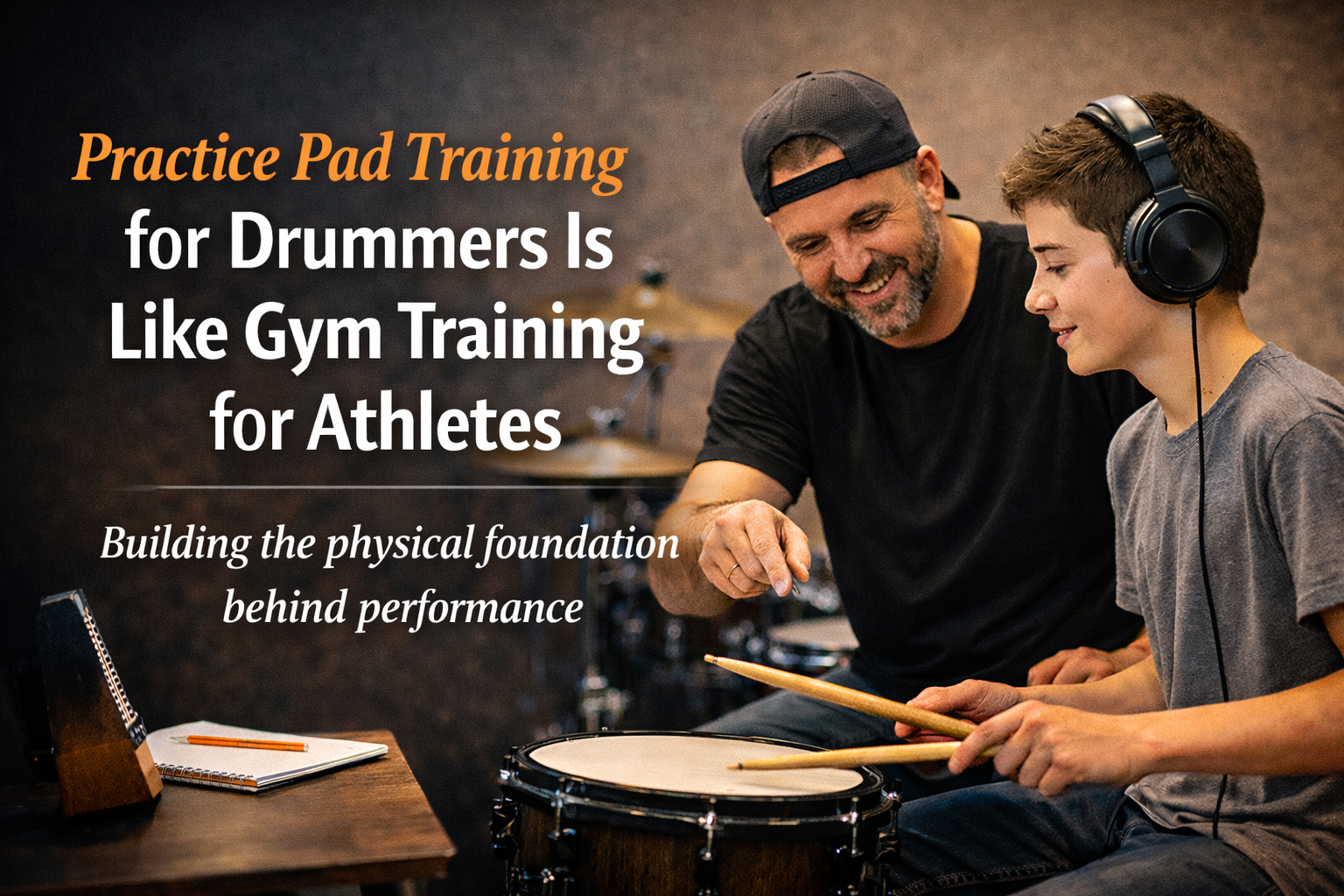
When people think about drumming, they often focus on the performance.
They notice the sound, the speed, the groove, the energy, and the confidence of the player.
But what they do not always see is the training behind it.
Just like athletes use gym training to build strength, coordination, endurance, and control, drummers use practice to build the physical and musical foundation behind performance.
At Home Drumming Academy, this idea is central.
We believe that structured practice is not just preparation for drumming. In many ways, it is drumming training itself.
A practice pad is not only a simple tool.
It is a training space where students develop the control, movement, coordination, endurance, and discipline that later appear in real playing.
Performance Is Built Before Performance
An athlete does not wait until game day to build strength.
The real work happens before the performance.
It happens through repetition, focused drills, conditioning, and consistency over time.
Drumming works in the same way.
The freedom, confidence, control, and musicality that people hear in a performance are usually built long before the student sits at a full drum set.
They are built through structured practice.
That is one reason practice pad work matters so much, especially for beginners.
It helps students build the foundation before they try to build complexity.
1. Practice Builds Physical Strength for Playing
Drumming is musical, but it is also physical.
The hands, wrists, fingers, arms, posture, and movement patterns all play an important role in how a student performs.
Just as athletes train the body to support performance, drummers train the body to support sound, control, and endurance.
Practice pad work helps students strengthen the muscles and movement habits needed for:
- better stick control
- clearer strokes
- stronger rebound
- greater stability
- more efficient movement
This physical training may not look dramatic, but it is essential.
Without a strong base, performance becomes harder, less controlled, and more tiring.
2. Practice Improves Coordination and Control
Athletes train movement patterns so the body can respond with precision.
Drummers do the same.
Every exercise on a practice pad helps train coordination between the hands, the mind, and the ear.
Students begin to develop:
- better timing
- more even strokes
- improved balance between hands
- greater accuracy
- smoother movement
This is one of the clearest ways drumming and athletic training connect.
Both require control, repetition, and attention to detail.
The goal is not random movement.
The goal is trained movement.
3. Practice Develops Endurance and Consistency
Athletes train so their body can perform well over time.
Drummers need that too.
A student may be able to play something correctly once. But real progress comes when they can repeat it with stability, confidence, and less tension.
Structured pad practice helps build endurance in both the body and the mind.
Students learn how to stay focused, maintain control, and keep quality consistent across repeated exercises.
Over time, this creates stronger playing habits and more reliable performance.
That is why short, focused, regular practice often brings better results than occasional long sessions without structure.
4. Practice Creates Discipline and Training Habits
Athletic progress does not come only from talent.
It comes from disciplined training.
The same is true in drumming.
Many students want to improve, but improvement becomes much more likely when practice turns into a routine.
A practice pad is powerful because it supports this habit.
It allows students to train consistently, even at home, even in a small space, and even when they do not have access to a full drum set.
This makes it easier to build one of the most valuable skills in any learning process:
the habit of showing up.
And when students learn to show up regularly, their foundation becomes stronger week by week.
5. Practice Builds the Foundation Behind Performance
Athletes do not become strong during the performance itself.
They reveal the strength they built during training.
Drummers do the same.
When a drummer performs with control, confidence, speed, balance, and musical clarity, those qualities are usually the result of steady practice done over time.
This is why practice pad work should never be seen as something small or secondary.
It is part of the real work.
It is where students develop the physical and musical base that supports future playing on the drum set, snare drum, or percussion instruments.
At Home Drumming Academy, this is one of the most important messages we want beginners to understand:
what you build in practice becomes what you can express in performance.
Why This Matters So Much for Beginners
Beginners often want to jump straight into songs, grooves, or impressive patterns.
That excitement is natural.
But without foundation, progress can become frustrating.
Students may feel stuck, inconsistent, tense, or unsure of what to improve first.
That is why beginner training should not begin with pressure to impress.
It should begin with building the right base.
Practice pad training helps beginners focus on the fundamentals that support everything else:
- technique
- timing
- coordination
- control
- endurance
- discipline
- confidence
These are not small things.
They are the building blocks of real drumming progress.
The Home Drumming Academy Approach
At Home Drumming Academy, we see practice as training for real musical growth.
Our goal is to help students build the physical and musical foundation of drumming through structured practice.
That includes:
- healthy movement habits
- technical development
- rhythmic control
- coordination
- endurance
- consistency
- confidence
This is especially valuable for beginner students learning from home.
With the right guidance, even simple tools like a practice pad can become part of a serious and effective training process.
That is how students begin to grow with more clarity, more confidence, and better long-term results.
Training First, Performance Next
A strong performance is not created by chance.
It is built step by step.
Just as an athlete trains in the gym to prepare for competition, a drummer trains in practice to prepare for music.
That is why practice should not be treated as something separate from progress.
Practice is the path to progress.
And for many beginners, the practice pad is one of the most important tools for building that path.
Final Thought
For a drummer, practice works like gym training for an athlete.
It builds the strength, coordination, control, endurance, discipline, and confidence behind performance.
That is why structured practice matters so much.
And that is why foundation must come first.
At Home Drumming Academy, we believe that when students train the right way, they do not just practice more.
They build better.
Ready to build your drumming foundation from home?
Start developing your technique, coordination, control, endurance, and confidence through structured practice with Home Drumming Academy today.